
Eisenhower Matrix
DAte
Category
Research
Reading Time
8 Min

The problem
The fastest way to lose support for any User Research initiative is to be dogmatic about doing in-depth research on every project. But for some, It can be challenging to know how or how little to do and how to ensure you’ll have stakeholder buy-in on your project. To streamline this decision-making process and to illustrate to your stakeholders that you are a good partner in reaching the OKRs of your business, I have adapted the Eisenhower Method, a prioritization framework, to evaluate how much or how little research to conduct based on two key factors: investment size and risk level.
The framework
The framework consists of a simple matrix divided into four quadrants based on two axes: the amount of development and design investment (small or large) and the associated risk (low or high). This creates a comprehensive approach to evaluate the necessity and depth of research needed for each project.
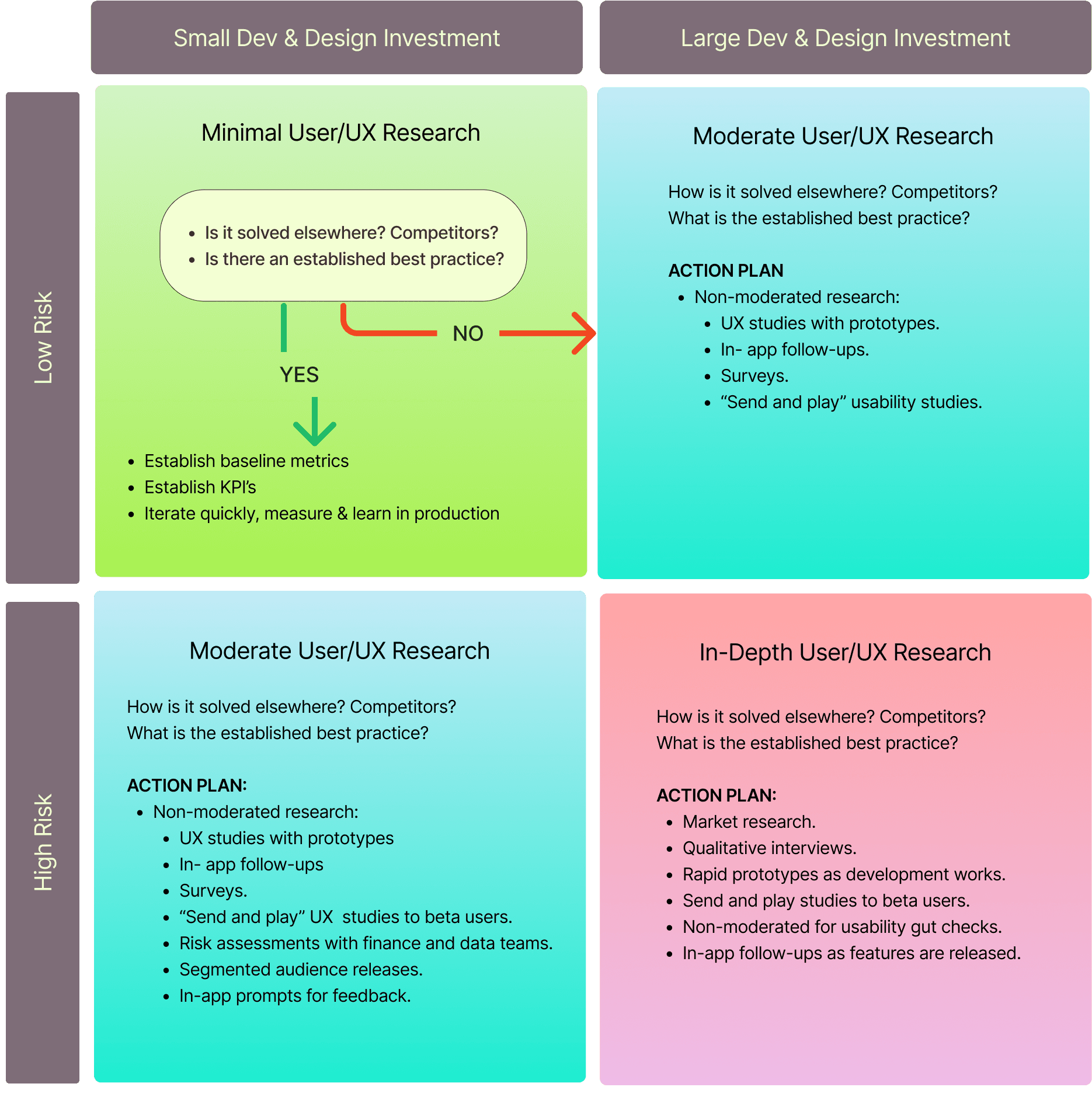
Low Risk, Small Investment:
In this quadrant, research is minimal. The focus is on identifying if competitors have solved similar problems and whether there are established best practices. If the answer is yes, I develop baseline metrics, define key performance indicators (KPIs), and plan to measure outcomes in production. This allows for quick validation without extensive research.
Low Risk, Large Investment
Here, I conduct user research to ensure the investment is justified. This includes exploring competitors’ solutions and establishing best practices through non-moderated research methods like prototype studies, surveys, and beta testing. The goal is to gather enough insights to guide the design and development process while mitigating potential risks.
High Risk, Small Investment
More research is warranted to ensure the investment is sound in this scenario. I delve into user/UX research, focusing on competitor analysis and established practices. Non-moderated approaches, such as surveys and limited audience releases with in-app feedback prompts, allow for iterative learning while minimizing resource expenditure.
High Risk, Large Investment
This quadrant demands in-depth user/UX research. To understand user needs and market fit, I prioritize user interviews, prototype testing, and comprehensive surveys. Utilizing non-moderated methods for open UX questions is essential to gathering significant data and mitigating risks associated with large investments.
My lean research program
→

Yvonne Doll
Product Design, Research, UX


