
Scaling for impact, not org charts
DAte
Category
Leadership
Reading Time
5 min

AI changes the leverage model. A small team can now move from an idea to research synthesis, interface exploration, working prototypes, content, and implementation details remarkably fast.
That does not automatically make the team more effective.
Without shared context, clear standards, and strong product judgment, AI can help a company build the wrong thing beautifully and at record speed.
My job as a design leader is no longer simply to scale output. It is to scale the organization’s ability to make good decisions.
Headcount is not the only measure of scale
AI can help teams explore directions, synthesize research, draft content, build prototypes, document decisions, and check work against standards.
What it cannot own is the judgment behind the work.
It cannot decide which problems matter, which evidence to trust, which tradeoffs are acceptable, or when something is ready for customers. It also cannot be accountable when things go sideways.
AI can increase output without increasing clarity. In a poorly structured organization, that means more duplication, inconsistency, and product drift.
The goal is not more artifacts. It is better outcomes with less unnecessary work.
Generalist versus specialist is the wrong debate
The better question is:
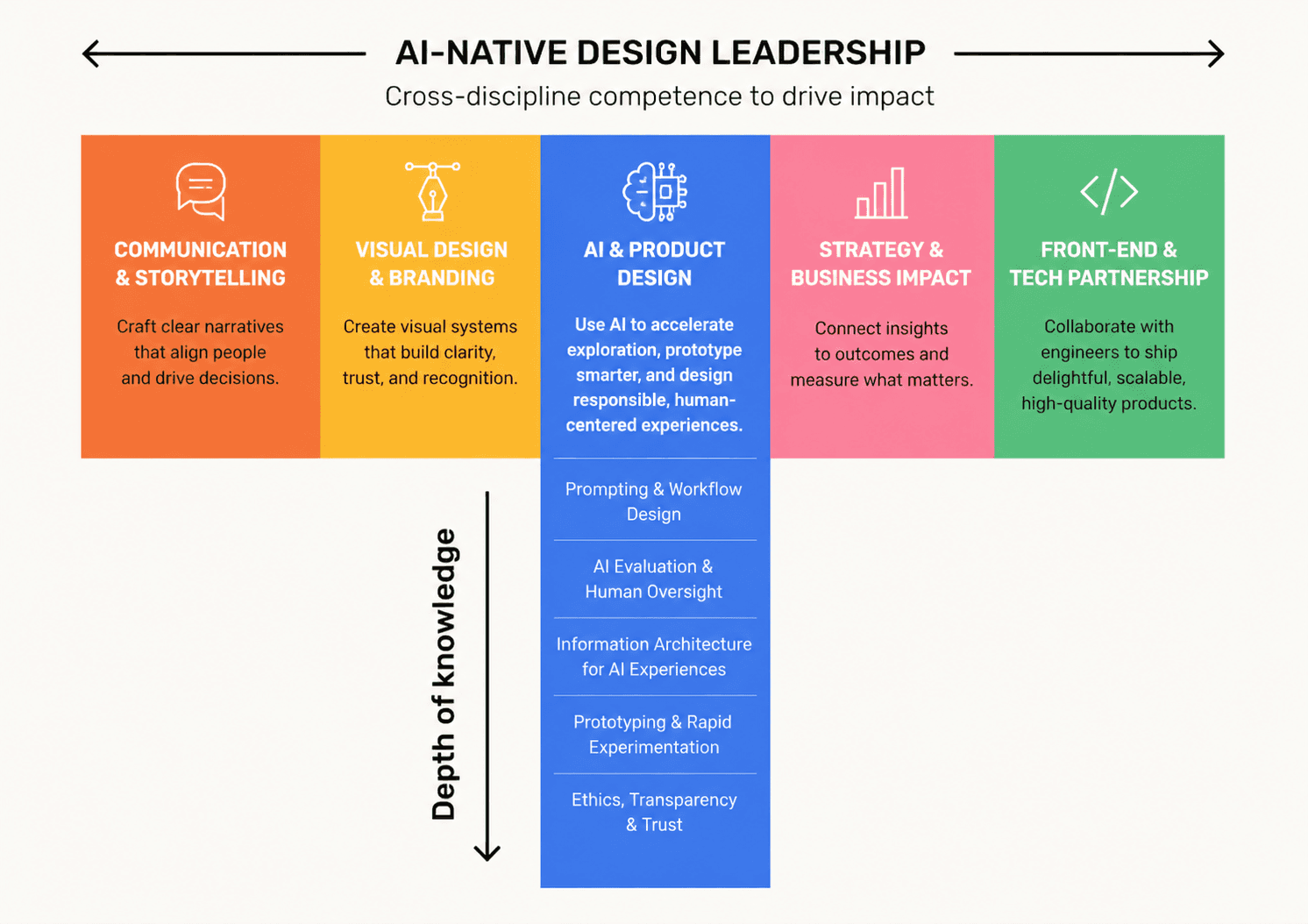
Where do we need breadth, where do we need depth, and who can connect the whole system?
Early-stage companies still need experienced generalists who can move across research, strategy, design, prototyping, and implementation.
Growing companies need specialists where a lack of depth is hurting product quality, customer trust, or business performance. That might include AI interaction design, research and evaluation, design systems, content, growth, accessibility, or design engineering.
Larger organizations need shared systems that create consistency without slowing teams down.
Central teams should create leverage, not become the Department of Permission.
Do not eliminate your future senior designers
AI can now handle some of the production work that once gave junior designers an entry point into the profession. That does not mean companies no longer need junior talent. It means leaders need to be more intentional about how junior designers develop judgment.
They need meaningful problems, customer context, feedback, opportunities to explain decisions, and practice evaluating AI output instead of blindly accepting it.
Automate every entry-level task and you may eventually discover you eliminated your future senior talent pipeline too.
AI fluency matters. Judgment matters more.
Being AI-forward should mean more than knowing which tool generates the prettiest interface.
Designers need to know how to:
Frame the problem before generating solutions
Provide useful context and constraints
Evaluate inconsistent or unsupported output
Design human supervision
Plan for error, recovery, and escalation
Decide where automation helps and where it creates risk
Explain AI behavior clearly to customers
Tools will change quickly. Judgment is the durable skill.
AI adoption is also not just a software rollout. It changes workflows, responsibilities, review points, and decision-making. It is an operating-model change.
Measure leverage, not AI activity
Counting prompts, prototypes, or generated screens tells you almost nothing.
Measure whether the organization is making better decisions and producing better outcomes:
Faster time to value
Less rework and fewer handoffs
Greater reuse and consistency
Better task completion and trust
Lower correction and escalation rates
More decisions grounded in customer evidence
Stronger business performance
The point is not to prove that people are using AI.
The point is to prove that the work is getting better.
The leadership shift
The AI-era design leader is not simply managing designers. We are designing the conditions that allow good work to happen repeatedly.
That means connecting design to company strategy, finding where AI creates real leverage, protecting work that requires human judgment, developing people, and building shared systems without creating bureaucracy.
AI may help some teams accomplish more without growing as quickly as they once did. But treating it as a headcount-reduction strategy misses the larger opportunity.
Scale the quality of the decisions.
Scale the systems that help strong work spread.
Scale impact, not just the team.
See how I scale design impact
→

Yvonne Doll
UX, Product Design, Design Leader, Research


